Friday, June 7, 2019

The Greatest Danger of the Concept of Social Justice Is That It Undermines and Destroys the Concept of a Rule of Law

The greatest danger of the concept of social justice, according to Hayek, is that it undermines and ultimately destroys the concept of a rule of law, in order to supersede merely “formal” justice, as a process governed by rules, with “real” or “social” justice as a set of results to be produced by expanding the power of government to make discretionary determinations in domains once exempt from its power. While Hayek regarded some advocates of social justice as cynically aware that they were really engaged in a concentration of power, the greater danger he saw in those sincerely promoting the concept with a zeal which unconsciously prepares the way for others—totalitarians—to step in after the undermining of ideological, political, and legal barriers to government power makes their task easier. Thus he regarded Nazism as “the culmination of a long evolution of thought” in Germany by socialists and others whose goals were vastly different from those of the Nazis, but who promoted the erosion of respect for legal rules in favor of the imperatives of specific social results.

--Thomas Sowell, A Conflict of Visions: Ideological Origins of Political Struggles, rev. ed. (New York: Basic Books, 2007), 221.


Green Extremism Is Rooted in One Conviction: Continued Economic Growth Is Absolutely Impossible, Given the Limits of a Finite Planet; Only If This Notion Is Discredited Can Eco-Radicalism Be Shaken

In the pages that follow I will argue that each of the four essential postulates of radical environmentalism outlined above is directly contradicted by the empirical record. “Primal” economies have rarely been as harmonized with nature as they are depicted; many have actually been highly destructive. Similarly, decentralized, small-scale political structures can be just as violent and ecologically wasteful as large-scale, centralized ones. Small is sometimes ugly, and big is occasionally beautiful. Technological advance, for its part, is clearly necessary if we are to dev elop less harmful ways of life and if we are to progress as a human community. And finally, capitalism, despite its social flaws, presents the only economic system resilient and efficient enough to see the development of a more benign human presence on the earth.

But a critique of these notions, however sound, misses the fundamental point. Ultimately, green extremism is rooted in a single, powerful conviction: the continued economic growth is absolutely impossible, given the limits of a finite planet. Only if this notion is discredited can the edifice of eco-radical philosophy be shaken.

--Martin W. Lewis, introduction to Green Delusions: An Environmentalist Critique of Radical Environmentalism (Durham: Duke University Press, 1992), 9-10.


Thursday, June 6, 2019

Radical Environmentalists, Like Biblical Millenarians, Scan the News and Popular Science Journals Eagerly for Every Scrap of Evidence that the Ecological End of Days Is Upon Us

Naively, one would think that environmentalists should welcome news that the planet is, in some respects, not in quite as much danger as we might have thought. This neglects, however, to allow for the psychodynamics of an apocalyptic vision. Radical environmentalists scan the news pages and the popular science journals eagerly for every scrap of evidence that the ecological End of Days is upon us. As with biblical millenarians, objections of logic and fact have little effect. They are already convinced that the world is in calamitous decline. They believe, and seem to enjoy believing, that nature is being violated—blasphemously—by their neighbors, and that ultimate retribution is on the way. Evidence to the contrary is viewed as a terrible letdown, not as a reprieve.

Similarly, inasmuch as ecoradicalism is a movement with a worshipful view of the primal, it takes little heed of sober findings that, in many cases, uncorrupted, nonwhite, primitive peoples have been just as contemptuous of what we call environmental values as are greedy Euro-American industrialists. As the geographer Martin Lewis notes in Green Delusions, “a large proportion of eco-radicals fervently believes that human social and ecological problems could be solved if only we would return to a primal way of life. Ultimately, this proves to be an article of faith that receives little support from the historical and anthropological record.”

--Paul R. Gross and Norman Levitt, Higher Superstition: The Academic Left and Its Quarrels with Science (Baltimore: Johns Hopkins University Press, 1998), e-book.


The Much Admired “Progressive” Writers Gave Up the Essential Idea of the Enlightenment: Freedom of Thought, Speech, and Communication

Lacking the power to think logically, and ignorant of history as well as of theory, the much admired “progressive” writers gave up the essential idea of the Enlightenment: freedom of thought, speech, and communication. Not all of them were so outspoken as Comte and Lenin; but they all, in declaring that freedom means only the right to say the correct things, not also the right to say the wrong things, virtually converted the ideas of freedom of thought and conscience into their opposite. It was not the Syllabus of Pope Pius IX that paved the way for the return of intolerance and the persecution of dissenters. It was the writings of the socialists. After a short-lived triumph of the idea of freedom, bondage made a comeback disguised as a consummation and completion of the philosophy of freedom, as the finishing of the unfinished revolution, as the final emancipation of the individual.

The concept of absolute and eternal values is an indispensable element in this totalitarian ideology. A new notion of truth was established. Truth is what those in power declare to be true. The dissenting minority is undemocratic because it refuses to accept as true the opinion of the majority. All means to “liquidate” such rebellious scoundrels are “democratic” and therefore morally good.

--Ludwig von Mises, Theory and History: An Interpretation of Social and Economic Evolution, ed. Bettina Bien Greaves (Indianapolis: Liberty Fund, 2005), 45.


Wednesday, June 5, 2019

Global Temperatures Have Flatlined or Fallen Since about 2001, Throwing a Monkey Wrench into Global Warming Theory that Doesn’t Allow for Cooling, so Global Warming Became Climate Change

Science is under attack like never before, especially by global warming alarmists. The alarmists would have us believe that doomsday is near, that a catastrophe awaits the Earth unless we stop pumping carbon dioxide (CO2) into the atmosphere by burning fossil fuels. It’s CO2 that is causing the climate to change, insist the believers. If we don’t do something about this pesky gas right now, our planet and our way of life will be destroyed.

This is utter nonsense. Global warming may be real, but there’s hardly a shred of good scientific evidence that it has very much to do with the amount of CO2 we’re producing, or even that temperatures have risen as much as warmists say.

Today’s climate change hysteria began 25 years ago with United Nations discussions that created the Intergovernmental Panel on Climate Change (IPCC). To climate change alarmists, the climate bible is a series of assessment reports issued by the IPCC about every six years. Based on the collective opinion of several hundred climate scientists, these reports are the source of the widely held belief, promulgated by Al Gore and other alarmists, that higher temperatures are the result of human activity.

Unfortunately, nature has not been cooperating. Global temperatures have flatlined or fallen since about 2001, throwing a monkey wrench into global warming theory that doesn’t allow for cooling because the CO2 level is constantly going upwards.

Not to be put out, the global warming faithful simply changed their tune. Global warming became climate change, despite the fact that the Earth’s climate had already been changing for thousands of years, long before industrialization boosted CO2. And the telltale sign that CO2 causes climate change became weather extremes instead of rising temperatures. Widespread wildfires in Russia, severe flooding in Pakistan, deadly tornadoes in the U.S., even harsh winters and record snowfalls – all of these are the result of man-made CO2, according to the alarmists.

How convenient. Just ignore the current cooling trend and blame every unusual weather event on CO2 and global warming. That may help drive political action on climate change, but it’s not science. True science is based on rigorous logic and evidence, not blind faith in quasi-religious dogma.

--Ralph B. Alexander, Global Warming False Alarm: The Bad Science Behind the United Nations' Assertion that Man-Made CO2 Causes Global Warming, 2nd ed. (Royal Oak, MI: Canterbury Publishing, 2012), Kindle e-book.


Tuesday, June 4, 2019

Afrocentrist Scholars Ward Off Criticism and Discussion of Their Claims and Theories by Calling Their Opponents Racists; Students Were Being Indoctrinated Along Party Lines

At first I was amazed that what I wrote had provoked hostility far beyond the range of ordinary scholarly disagreement. I was accused of being inspired by racist motives and later of being the leader of a Jewish “onslaught.” An influential Afro-centrist writer, Professor Molefi Kete Asante of Temple University, dismissed my whole discussion as an expression of white prejudice: “Lefkowitz and those who share her views are not interested in understanding Afrocentricity. Their intention is fundamentally the same projection of Eurocentric hegemony that we have seen for the past five hundred years.” Asante tried to cast doubt on everything that I said in my New Republic article. For instance, I reported that I had been surprised when one of my students told me that she had always thought Socrates was black and was concerned that I had never mentioned his African origins. Asante suggested that I had invented the incident, and that my surprise was motivated by “white racism.” Apparently Asante believed I could not endure the thought that Socrates might be black, whereas in reality I doubted that he was black because there was no evidence to support such a contention. Asante, in fact, is aware that there is no such evidence and says that for him the matter is “of no interest.” Why didn’t he imagine that I was responding in the same way as he was? Because there was no evidence, it was not an interesting question.

If Afrocentrist scholars could ward off criticism and even discussion of their claims and theories by calling their academic opponents racists, there seemed to be little hope of sponsoring the kind of debate that has until recently been a central feature of academic life. Rather than being encouraged to ask questions, to read widely, and to challenge any and all assumptions, students were being indoctrinated along party lines. What could be done to improve the situation before Afro-centrists walled their students off into a private thought- world of their own? It is not enough simply to raise questions about some of the more outlandish Afrocentric allegations. There is a need for explanation. There is a need to show why these theories are based on false assumptions and faulty reasoning, and cannot be supported by time-tested methods of intellectual inquiry. There is a need to explain why this misinformation about the ancient world is being circulated, and to indicate that the motives behind it are political, and that this politicizing is dangerous because it requires the end to justify the means.

--Mary Lefkowitz, preface to Not Out of Africa: How Afrocentrism Became an Excuse to Teach Myth as History (New York: BasicBooks, 1996), xii-xiii.


The Merging of these Two Developments in Epistemology and the Political/Economic Spheres Yielded the Surging to Prominence of Non-Rational and Irrationalist Left Socialisms

While some on the Left modified their ethics, others set to revising Marxist psychology and epistemology. Beginning in the 1920s and 1930s there had been some early suggestions that Marxism was too rationalistic, too logical and deterministic. In the 1920s, Mao had urged that will and assertion of the peasants and especially of the leaders counted for more than passively waiting for the material conditions of revolution to work themselves out deterministically. In the 1930s, Antonio Gramsci had rejected the belief that the Depression would necessarily spell the doom of capitalism, and he had argued that finishing capitalism off would require the creative initiative of the masses. That creative initiative, Gamsci argued, was however neither rational nor inexorable but rather subjective and unpredictable. And early Frankfurt School theorizing had suggested that Marxism was too wedded to reason, that reason led to major social pathologies, and that less rational psychological forces had to be incorporated into any successful social theory.

Those voices were mostly ignored for two decades, swept aside by the dominant voices of classical Marxist theory, the Depression and World War II, and by the conviction that the Soviet Union was showing the world the true path.

By the 1950s, however, two developments began to merge, one epistemological and one political-economic. In the world of academic epistemology, both European and Anglo-American theorists were reaching skeptical and pessimistic conclusions about the powers of reason: Heidegger was ascendant on the Continent and Logical Positivism was reaching its dead end in the Anglo-American world. And in both theoretical and practical politics and economics, the failure of Marxism to develop according to the logic of its traditional theory was reaching a crisis. The merging of these two developments yielded the surging to prominence of non-rational and irrationalist Left socialisms.

--Stephen R. C. Hicks, Explaining Postmodernism: Skepticism and Socialism from Rousseau to Foucault (Tempe, AZ: Scholargy Publishing, 2004), e-book.


Monday, June 3, 2019

Human-Induced Global Warming Is Where One Camp Attempts to Demolish Basic Principles of Science in order to Install a New Order based on Political and Sociological Collectivism

When science was born, the consensus at that time was driven by religion, politics, prejudice, mysticism and self-interested power. From Galileo to Newton and through the centuries, science debunked the consensus by experiment, calculation, observation, measurement, repeated validation, falsification and reason. Appeals to consensus are not new. The methodology of science allows problems to be solved, whereas the science of the global warmers is designed to confirm a political opinion. There is a consensus regarding the science of global warming but only amongst ascientific environmental activists.

Scientific fact now no longer seems to be necessary. Human-induced global warming is one such example, where one camp attempts to demolish the basic principles of science and install a new order based on political and sociological collectivism. Science is becoming a belief system wherein the belief with the greatest number of followers becomes the established fact and received knowledge. This belief is sustained by consensus and authority. With this new authoritarian science based on consensus and espoused by UN’s IPCC and other agencies as authorities, it appears that true science does not matter any more. If Mann’s “hockey stick” chart showing rising global temperature is based on fraud and invalid statistical methods, it just does not matter because we still have a consensus.

--Ian Plimer, Heaven and Earth: Global Warming; The Missing Science (Ballan, AU: Connor Court Publishing, 2009), e-book.


Granting the State Plenary Power to Determine the Truth Is to Unwind the Enlightenment; the Platforms that Are Otherwise Given to Academics and Experts Are Denied to Dissenters, No Matter Their Credentials

Lavik argues (ibid.) that the utilitarian justification for free speech first propounded by John Stuart Mill does not apply to ‘a well-organised and wellfunded campaign by a person or group with authority in society, which keeps repeating the same untrue and damaging claims about climate change, without mentioning conclusive counter-arguments’. This is so because while freedom of speech generally advances the pursuit of truth, this is not true for utterances that are not sincerely meant.

Not stated is how it is that the truth of a claim, and the sincerity behind it, are to be judged. By what principle might a threshold of sincerity be set, above which speech is permitted and below which it is prohibited? The establishment of that standard is itself to make a truth claim and therefore to prevent debate about whatever is in contention.

In short, granting the state plenary power to determine the truth is to unwind the Enlightenment. No dissent from established truths could ever be tolerated.

For this reason, it is not an exaggeration to say that climate change alarmists are attempting to establish themselves as a kind of clerisy. If that sounds hyperbolic, consider the following argument, presumably made sincerely, by a pair of Australian academics (Shearman and Smith cited in Berg 2007):
[T]here is some merit in the idea of a ruling elite class of philosopher kings. These are people of high intellect and moral virtue … These new philosopher kings or ecoelites will be as committed to the value of life as the economic globalists are to the values of money and greed.
An elite class of people to protect unimpeachable truths, to proselytise the good word to the unconverted, and to tend to the needs of the initiated – climate change has taken on a quasi-religious quality. It shouldn’t surprise then that since climate change sceptics are dissenters from the high church of scientism, they must be silenced and banished.

The elite cabal of scientists who dominate climate change research have been militant in shunning those with whom they disagree. Their instinct is to protect their turf rather than to engage in free debate. This contributes to a powerful chilling effect that, in concert with the state’s campaign of harassment, discourages dissenters from voicing their opinions.

For example, the platforms that are otherwise given to academics and experts are denied to dissenters, no matter their credentials. Danish statistician Bjørn Lomborg came to prominence in 2001 with his book The Sceptical Environmentalist, in which he argued that many policies advocated by climate change alarmists would be ineffective and wasteful. In 2015, Lomborg agreed to move his research centre to the University of Western Australia, with funding coming from the Australian government. But under pressure from academic staff and student activists, the university’s vice chancellor pulled out of the deal. Subsequent discussions with Flinders University floundered immediately as staff and students reacted angrily to the idea that someone might ever produce research they disagreed with (Hasham 2015).

--Simon Breheny, “Free Speech and Climate Change,” in Climate Change: The Facts, 2017, ed. Jennifer Marohasy (Melbourne: Institute of Public Affairs, 2017), e-book.


Sunday, June 2, 2019

If All Privilege Is Abolished, Learning Is Abolished Too; a Society MUST Be Barbarously Ignorant If There Is No Privilege in It at All, Only Equality All Round

Are you an opponent of privilege? It is ten thousand to one you are. In that case you are, though you may not know it, an opponent of learning too. The reason is simple: leisure, quiet, and access to the learning of others are privileges, and they are also three things without which learning cannot exist.

No two of those three will do on their own. Leisure and quiet will not save learning if the learning of others is not also accessible to you—in short, if there are no libraries. If you have libraries and the leisure to use them, but every moment of waking life is filled with loud noise from Red Guards, rock music, or some other source, the libraries and leisure might as well not exist as far as learning is concerned. If you have the libraries and the quiet which learning requires, but no one has enough leisure to profit from them, then learning will be extinguished just as surely as if you simply shot every educated person in the head, Khmer-Rouge style.

So, if all privilege is abolished, learning is abolished with it. A society in which privilege exists may be a barbarously ignorant one; we all know many instances of that. But a society must be barbarously ignorant if there is no privilege in it at all, only equality all round.

Are you inclined to dismiss this proposition as belonging to the age of illuminated manuscripts? You should not, because it remains equally true in the age of word-processors. It is also true of every branch of learning indifferently: physics, history, philosophy, mathematics, or whatever. A life largely devoted to any of these things need not be privileged with respect to wealth or power, but it must  be privileged with respect to leisure, libraries, and quiet. This is simply a fact about Homo sapiens. It may be otherwise with some other species on another planet; but it is not otherwise with us.

--David Stove, On Enlightenment, ed. Andrew Irvine (New Brunswick, NJ: Transaction Publishers, 2003), 3-4.


Stewart Taught Future Prime Ministers to see the Legislator as an Experimental Scientist or Inventor; “the Science of Legislation” Removed the Obstacles to Commercial Society and Its Social Order

Of course, other Scottish thinkers had talked about politics as an exact science—David Hume had even written an essay on it. But they had looked for a scientific model as a way to understand politics and human conduct. Stewart was looking for a scientific way to organize it, and perhaps even create something new and better. He taught his students, including future prime ministers, to see the legislator in almost the same position as the experimental scientist or the inventor: applying mind and method to matter, in order to facilitate human happiness. Stewart was no utopian; this was not a blueprint for building a new society from scratch. Rather, he saw “the science of legislation” in Adam Smith’s terms, removing the obstacles that hinder the natural progress of commercial society and its social order. But he did introduce a new notion to the Scottish school. Political progress could take place in the same way it took place in mathematics or chemistry: by exhaustive investigation and research, by developing a clear theory that explained the facts, and then applying it.

--Arthur Herman, How the Scots Invented the Modern World: The True Story of How Western Europe's Poorest Nation Created Our World and Everything in It (New York: Three Rivers Press, 2001), 271-272.


Saturday, June 1, 2019

The Hockey Stick, the “Smoking Gun” for Man-made Global Warming, Miraculously Did Away with the Medieval Warm Period and the Little Ice Age

A team led by Professor Michael Mann of the University of Virginia (since departed for other, dare I say "greener" pastures) published a chart in Nature magazine in 1998 purporting to reconstruct global temperatures, showing a stable climate for six hundred years. In 1999 Mann extended the reconstruction to cover 1,000 years, showing temperature as having been stable throughout. This miraculously did away with well-established climatic phenomena known as the Medieval Warm Period, followed by a Little Ice Age. These phenomena, it turned out, actually did appear in his data, but didn't find their way into his representation.

The result was the "Hockey Stick" graph-so called because it appeared to resemble a hockey stick on its side, the shaft being a 900-year straight line followed by a spike in temperature-the blade. This confirmed everything the climate alarmists hoped for. It was touted as the "smoking gun" for Manmade global warming by establishing that, until human influence, climate was largely stable.

In 2001, the "IPCC Third Assessment Report" included the Hockey Stick, giving it prominent placement, in the Technical Summary, as well as the second page of the Summary for Policymakers (that section which has proven time and again to be the only one read by journalists or politicians and, as either a cause or effect of that truth, chock-full of alarmism not justified by the underlying work). In short, no one could possibly miss it. Of course, this reconstruction wildly contradicted the IPCC's own previous report, as well as extensive history and climate scholarship.

--Christopher C. Horner, Global Warming and Environmentalism (Washington, DC: Regnery Publishing, 2007), 120.


Friday, May 31, 2019

Cultural Marxists Understand that the Revolution Requires a Cultural War More Than an Economic War; Orthodox Marxism's Rigidity Prevented Revolutionary Changes in Marriage, Sexuality, and Family

For the neo-Marxists, orthodox Marxism was too limiting; it was too narrow, too restrictive, too reactionary even, too controlled by the Comintern that strong-armed national communist parties from upon high in Moscow with its ironclad party discipline. This rigidity prevented these more freewheeling neo-Marxists from initiating the cultural transformation they craved, including revolutionary changes in marriage, sexuality, and family. These Frankfurt leaders were left-wing intellectuals who looked to the universities as the home base from which their ideas could be launched. They spurned the church and looked to Marx and Freud as the gods who they believed would not fail them. Rather than organize the workers and the factories, the peasants and the fields and the farms, they would organize the students and the academy, the artists and the media and the film industry.

One can look at the Frankfurt school’s “cultural Marxism” not as a replacement for classical Marxism, but as the accelerator pedal that was missing from the wheezing, stalling vehicle of classical Marxism. It offered a gear shift into warp-speed. The cultural Marxist agrees with the classical Marxist that history passes through a series of stages on the way to the final Marxist utopia, through slavery and capitalism and socialism and ultimately to the classless society. But the cultural Marxist recognizes that the communists will not get there by economics alone. In fact, the classical Marxists would utterly fail to take down the West with an economic revolution; capitalism would always blow away communism, and the masses would choose capitalism. Cultural Marxists understand that the revolution requires a cultural war more than an economic war. Whereas the West—certainly America—is not vulnerable to a revolt of the downtrodden trade-union masses, it is eminently vulnerable when it comes to, say, sex or porn. While a revolution for wealth redistribution would be unappealing to the citizens of the West, a sexual revolution would be irresistible. Put the bourgeoisie in front of a hypnotic movie screen, and they would be putty in your hands. Thus, what was needed was a cultural Marxism.

--Paul Kengor, The Politically Incorrect Guide to Communism (Washington, DC: Regnery Publishing, 2017), e-book.


The Terms of Reference of the Classical Theory of Knowledge Included the Assumption that There WAS a Right and Wrong Way of Going about the Acquisition of Knowledge

Culture (which Descartes named ‘custom and example’) was, in the Cartesian programme, the source of error. That is of course an abomination to those imbued with the postmodernist spirit. What Descartes and his successors said, in effect, was that there are an awful lot of meanings and opinions about, that they cannot all be right, and that we’d better find, and justify, a yardstick which will sort out the sheep from the goats. For Descartes, the yardstick involved the exclusive use of clear and distinct meanings, so clear and distinct as to impose their authority on all minds sober and determined enough to heed them, irrespective of their culture. The path to truth lay through voluntary cultural exile. The terms of reference of the central, classical theory of knowledge included the assumption that there was a right and wrong way of going about the acquisition of knowledge: the problem was to find the difference, and, when it was located, to justify it. The contemporary idea is that there is no difference, that to set up ranking between kinds of knowledge is morally and politically wicked, rather like setting up one skin colour above another (with more than a hint that perhaps the two discriminations were linked to each other).

--Ernest Gellner, Postmodernism, Reason and Religion (London: Routledge Taylor and Francis e-Library, 2003), 37-38.


The Path Leads from Marxist Elimination of Opponents for Pseudo-Objectivity, to Frankfurt Castigation of Superficial Positivism to Postmodern Repudiation of Objectivity

So the path leads from Marxist elimination of opponents for alleged pseudo-objectivity, to Frankfurt castigation of superficial positivism equated with the amassing of surface facts, to postmodernist repudiation of the very aspiration to objectivity, and its replacement by hermeneutics: this is the one line of logical development which strikes me, whether or not it really corresponds to the participants’ own view of their intellectual ancestry, or to the actual historical links. That remains to be explored and documented. . . .

The point is that the great epistemological tradition in Western philosophy (now claimed to be overcome), stretching from Descartes to Hume and Kant and beyond, formulated the problem of knowledge, not in terms of a kind of egalitarian hermeneuticism, or of hermeneutic egalitarianism, but, rather, in terms of a discriminating cognitive Elitism. It did indeed hold all men and minds, but not all cultures and systems of meaning, to be equal. All minds were endowed with the potential of attaining a unique objective truth, but only on condition of employing the correct method and forswearing the seduction of cultural indoctrination.

--Ernest Gellner, Postmodernism, Reason and Religion (London: Routledge Taylor and Francis e-Library, 2003), 37.


Appealing to “Facts” or “the Truth” in Connection to the Study of Race, Gender, Violence, and Social Organization Is Just a Ruse, the Relativists Say, Because There Is No “Truth”

According to the relativistic wisdom prevailing in much of academia today, reality is socially constructed by the use of language, stereotypes, and media images. The idea that people have access to facts about the world is naive, say the proponents of social constructionism, science studies, cultural studies, critical theory, postmodernism, and deconstructionism. In their view, observations are always infected by theories, and theories are saturated with ideology and political doctrines, so anyone who claims to have the facts or know the truth is just trying to exert power over everyone else.

Relativism is entwined with the doctrine of the Blank Slate in two ways. One is that relativists have a penny-pinching theory of psychology in which the mind has no mechanisms designed to grasp reality; all it can do is passively download words, images, and stereotypes from the surrounding culture. The other is the relativists' attitude toward science. Most scientists regard their work as an extension of our everyday ability to figure out what is out there and how things work. Telescopes and microscopes amplify the visual system; theories formalize our hunches about cause and effect; experiments refine our drive to gather evidence about events we cannot witness directly. Relativist movements agree that science is perception and cognition writ large, but they draw the opposite conclusion: that scientists, like laypeople, are unequipped to grasp an objective reality. Instead, their advocates say,"Western science is only one way of describing reality, nature, and the way things work-a very effective way, certainly, for the production of goods and profits, but unsatisfactory in most other respects. It is an imperialist arrogance which ignores the sciences and insights of most other cultures and times,"! Nowhere is this more significant than in the scientific study of politically charged topics such as race, gender, violence, and social organization. Appealing to "facts" or "the truth" in connection with these topics is just a ruse, the relativists say, because there is no "truth" in the sense of an objective yardstick independent of cultural and political presuppositions.

--Steven Pinker, The Blank Slate: The Modern Denial of Human Nature (New York: Penguin Books, 2003), 198.


Wednesday, May 29, 2019

Only the State Obtains Its Revenue by Coercion; That Coercion Is Known as “Taxation,” although in Less Regularized Epochs It Was Often Known as “Tribute”

But, above all, the crucial monopoly is the State's control of the use of violence: of the police and armed services, and of the courts-the locus of ultimate decision-making power in disputes over crimes and contracts. Control of the police and the army is particularly important in enforcing and assuring all of the State's other powers, including the all-important power to extract its revenue by coercion.

For there is one crucially important power inherent in the nature of the State apparatus. All other persons and groups in society (except for acknowledged and sporadic criminals such as thieves and bank robbers) obtain their income voluntarily: either by selling goods and services to the consuming public, or by voluntary gift (e.g., membership in a club or association, bequest, or inheritance). Only the State obtains its revenue by coercion, by threatening dire penalties should the income not be forthcoming. That coercion is known as "taxation," although in less regularized epochs it was often known as "tribute." Taxation is theft, purely and simply even though it is theft on a grand and colossal scale which no acknowledged criminals could hope to match. It is a compulsory seizure of the property of the State's inhabitants, or subjects.

--Murray N. Rothbard, The Ethics of Liberty (New York: New York University Press, 1998), 162.


Tripoli, Tunis, Algiers, and Morocco Were Moslem States and They Extorted Tribute from Europe through Terror; the Dutch, Danes, Swedes, and Venetians All Paid Annual Tribute to the Barbary States

Jay already had instructed Adams and Jefferson to make treaties with the Barbary States, authorizing them to pay up to $80,000 in borrowed money from Holland, or wherever they could get credit for the customary presents. However, before the ministers entered any negotiations, they wanted to learn what the European nations were paying, and they almost surely took time to review their small store of facts about the Barbary States.

It was widely known among educated Americans that Tripoli, Tunis, Algiers, and Morocco were Moslem states and extorted tribute from Europe through terror. Less well known was the fact that Tripoli, Algiers, and Tunis were regencies of the Ottoman Empire, but Morocco was not. The three regencies were ostensibly under the rule of the sultan in Constantinople, but in truth they were virtually autonomous—and remained that way so long as they sent the sultan gifts periodically—and each regency had evolved its own succession. While the Barbary States, with Algiers historically predominant, presented a solid, menacing front to Christian Europe and America, they negotiated treaties independently, competed fiercely with one another and occasionally quarreled over territory, sometimes to the extent of going to war. And, confusingly, Algiers, Tunis, and Tripoli happened to be the names of the capital cities of their respective countries; Tangier was Morocco’s capital.

At the end of their inquiry into European tributary payments, Jefferson and Adams knew only that the Dutch, Danes, Swedes, and Venetians all paid annual tribute—Venice in jewels and gold coins called sequins, and the others in naval stores and ammunition—but not how much. What would it cost for the United States to buy peace? The American diplomats didn’t know. Consequently, by early 1786 the two ministers had not even attempted to open treaty negotiations with any of the Barbary States.

--Joseph Wheelan, Jefferson's War: America's First War on Terror, 1801-1805 (New York: Carroll and Graf Publishers, 2004), e-book.


Monday, May 27, 2019

Southerners Saw Their Political Circumstances As Being Parallel to Those of the Founding Fathers: Both Were Dissolving Lockean Compacts (The British Empire and the USA) Justified by the Lockean Right of Revolution

John Locke had been dead a long time in 1861. Southern secessionists, however, resurrected him and the American revolutionaries of 1776, for whom he was the essential political patriarch. Southerners perceived their political circumstances as being parallel to those of the Founding Fathers: both sets of revolutionaries believed that they were dissolving Lockean compacts—the British Empire and the United States of America. For a time, the secessionists argued, these compacts had served the best interests of the contracting parties. Then, just as George III and his Parliament threatened the well being of the American colonies, so Abraham Lincoln and his Republican Congress threatened the essentials of the Southern way of life. Similar problems called forth similar solutions—secession and independence—justified by the Lockean theory of the right of revolution.

--Emory M. Thomas, The Confederate Nation, 1861-1865 (Pymble, NSW: HarperCollins e-books, 2010), e-book.


The Author Is Interested in Casting White Slavery in the Maghreb (the Arabic Name for Northwest Africa) in the Terms Developed to Cope with trans-Atlantic Slavery (the Bondage of Black Africans to Whites)

This book has come out of my desire to rethink the story of European enslavement in the early modern Mediterranean world - to place, as much as possible, this always rather neglected, even derided, form of slavery in the larger context of slave studies world-wide. I have been particularly interested in casting white slavery in the Maghreb in the terms that have been developed by historians and sociologists to cope with the much vaster and politically fraught topic of trans-Atlantic slavery - the bondage of black Africans to white Europeans or Americans that has become for many scholars the archetype and model of all slave studies. In part, I chose to do so because the topics and approaches that have grown up around American slavery provide such fertile conceptual ground fo r application to the Barbary Coast, where slavery is a hardly unknown, but still strangely neglected field in intellectual (as opposed to narrative) terms. In the course of my study of the so-called Barbary regencies and of the Italians who were caught up in the Islamic slavery practiced there, I was also increasingly impressed by other reasons that make these two arenas of bondage - black/ American and white/African - an especially appropriate intellectual and historical pairing.

--Robert C. Davis, introduction to Christian Slaves, Muslim Masters: White Slavery in the Mediterranean, the Barbary Coast, and Italy, 1500-1800 (Houndmills, UK: Palgrave Macmillan, 2004), xxiv.


With So Few Jews in the South at the Time, It Is Astonishing that One Should Appear at the Very Center of Southern History

I first became curious about Judah P. Benjamin fifteen years ago when I began my research for The Provincials: A Personal History of Jews in the South. I was intrigued with the ways n which Jews and Southerners were alike--stepchildren of an anguished history--and yet how different. Whereas the Jewish search for a homeland contrasted with the Southerner's commitment to place, Southern defenders of the Confederacy often used Old Testament analogies in referring to themselves as “the chosen people” destined to survive and triumph against overwhelming odds. Benjamin fascinated me then because of the extraordinary role he played in Southern history and the ways in which Jews and non-Jews reacted to him. He was the prototype of the contradictions in the Jewish Southerner, and the stranger in the Confederate story, the Jew at the eye of the storm that was the Civil War. Objectively, with so few Jews in the South at the time, it is astonishing that one should appear at the very center of Southern history. Benjamin himself avoided his Jewishness throughout his public career, though his enemies in the Southern press and in the halls of the Confederate Congress never let the South forget it.

--Eli N. Evans, prologue to Judah P. Benjamin: The Jewish Confederate (New York: Press Press, 1988), xi-xii.


Attacking American Society and Western Civilization and Inducing Guilt to Extract Benefits from White Populations Are Greatly Enhanced by Making Enslavement Appear to be a Peculiarly American and White Crime

Slavery was an evil of greater scope and magnitude than most people imagine and, as a result, its place in history is radically different from the way it is usually portrayed. Mention slavery and immediately the image that arises is that of Africans and their descendants enslaved by Europeans and their descendants in the Southern United States—or, at most, Africans enslaved by Europeans in the Western Hemisphere. No other historic horror is so narrowly construed. No one thinks of war, famine, or decimating epidemics in such localized terms. These are afflictions that have been suffered by the entire human race, all over the planet—and so was slavery. Had slavery been limited to one race in one country during three centuries, its tragedies would not have been one-tenth the magnitude that they were in fact.

Why this provincial view of a worldwide evil? Often it is those who are most critical of a “Eurocentric” view of the world who are most Eurocentric when it comes to the evils and failings of the human race. Why would anyone wish to arbitrarily understate an evil that plagued mankind for thousands of years, unless it was not this evil itself that was the real concern, but rather the present-day uses of that historic evil? Clearly, the ability to score ideological points against American society or Western civilization, or to induce guilt and thereby extract benefits from the white population today, are greatly enhanced by making enslavement appear to be a peculiarly American, or a peculiarly white, crime.

--Thomas Sowell, “The Real History of Slavery,” in Black Rednecks and White Liberals (San Francisco: Encounter Books, 2005), 111.


Saturday, May 25, 2019

Social Justice Is the Progeny of Postmodern Theory; I Call Contemporary Social Justice “Practical Postmodernism” Or “Applied Postmodern Theory”

The derailment of academic institutions harms not only students but it also threatens the broader society, not only by undermining faith in knowledge claims but also by prejudicing the institutions supposed to cultivate the well-versed, thinking, and reasonable people required in a democratic society – people capable of open inquiry, debate, disagreement, and conflict resolution, without recourse to masks and knives.

How did this treacherous situation come to pass? How did the social justice creed gain dominance in academia? How and why was it made official policy in most colleges and universities in North America? Where did this social justice movement come from and how has it managed to permeate the broader culture and contend for domination?

To address these questions, we must look at the lineage of contemporary social justice. As I’ve said, social justice is the progeny of postmodern theory. Its beliefs, practices, values, and techniques bear the unmistakable birthmarks of postmodernism – although one must know what to look for. For this reason, and because social justice is having such a real-world impact, I call contemporary social justice “practical postmodernism,” or “applied postmodern theory.” These phrases should strike reasonable readers familiar with postmodernism as oxymoronic. How could such an obscure, anti- pragmatic, and nearly indescribable set of propositions as postmodern theory ever be applied or made practical?, they rightly ask. By being put into practice, I answer. Contemporary social justice is the very impractical “practical” application of postmodern theory to everyday life.

--Michael Rectenwald, preface to Springtime for Snowflakes: “Social Justice” and Its Postmodern Parentage (Nashville, TN: New English Review Press, 2018), xiii.


In the New Orthodoxy She Had Embraced, a Mythical “Patriarchy” Took Precedence over the Marxist Ruling Class as the Well-Spring of Social Evils

In graduate school, Bettina had begun for the first time in her life to open her mind to the work of leftwing writers who were not on the Party's list of approved authors. At the same time, she was careful to limit the range of her interest to the writings of authors who were politically correct by the standards of her New Left comrades: “radical feminists, authors who applied a Marxist paradigm to gender issues,” and those approved by the Women's Studies movement such as Shulamith Firestone and Juliet Mitchell, authors of The Dialectics of Sex and Women: The Longest Revolution. In the new orthodoxy she had embraced, a mythical “patriarchy” took precedence over the Marxist ruling class as the well-spring of social evils. In the radical vision she now adopted, women took their place beside the proletariat as a fundamental element in the axis of social “oppression” and thus in the revolutionary struggle for “social justice.”

--David Horowitz, Radicals: Portraits of a Destructive Passion (Washington, DC: Regnery Publishing, 2012), 86.


Friday, May 24, 2019

Until Its Steep Military Decline in the Nineteenth and Twentieth Centuries, Islam Was the Arch-Enemy of European Civilization

It can fairly be said that, until its steep military decline in the nineteenth and twentieth centuries, Islam was the arch-enemy of European civilization. For virtually all of Europe’s history since the Dark Ages it had been a mortal threat. Between the seventh and ninth centuries, militarized Islam conquered half of the fragmented Roman Empire. “It very nearly destroyed us,” wrote Hilaire Belloc in 1938. At the time, Belloc thought it dangerous that Westerners
have forgotten all about Islam. They have never come in contact with it. They take for granted that it is decaying, and that, anyway, it is just a foreign religion which will not concern them. It is, as a fact, the most formidable and persistent enemy which our civilization has had, and may at any moment become as large a menace in the future as it has been in the past…It has always seemed to me possible, and even probable, that there would be a resurrection of Islam and that our sons or our grandsons would see the renewal of that tremendous struggle between the Christian culture and what has been for more than a thousand years its greatest opponent.
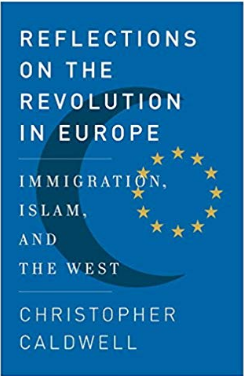
--Christopher Caldwell, Reflections on the Revolution in Europe: Immigration, Islam, and the West (New York: Doubleday, 2009), Kindle e-book.